
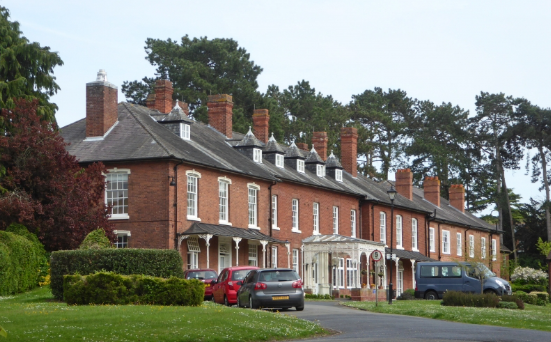
Housing association refurbishment by Midlands Building & Maintenance at The Heriotts, Droitwich.
On 30 November 2026, the second phase of Awaab's Law comes into force. For registered providers across Worcestershire, Gloucestershire and the wider Midlands it is the most significant change to repairs obligations in a generation, and it lands in four months.
The first phase, in force since 27 October 2025, applied fixed statutory timescales to all emergency hazards and to significant damp and mould. Phase two extends those timescales to seven further hazard categories: excess cold and excess heat, falls on stairs and between levels, structural collapse and falling elements, fire and electrical hazards, explosions, and domestic hygiene including pest infestation. Phase three, expected in 2027, will bring in almost everything remaining under the Housing Health and Safety Rating System.
The Ministry of Housing, Communities and Local Government published the phase two guidance on 13 July 2026, and its own impact assessment puts the cost to the sector at around £213 million.
We work with housing association clients on both planned and responsive work, and this article sets out what we think the change actually asks of a contractor. It is written for asset managers, repairs leads and property directors rather than for tenants.
What the timescales require
Under phase two the obligations are specific and they are counted in days rather than judged after the fact.
Where a hazard presents an imminent and significant risk, the landlord must investigate and make the property safe within 24 hours. Where it presents a significant but non-emergency risk, a standard investigation must be completed within 10 working days. A written summary of the findings and the proposed action must reach the resident within three working days of that investigation concluding. Urgent safety works must be completed within five working days of the investigation. Longer-term remedial works must begin within 12 weeks.
If the property cannot be made safe within those windows, the landlord must offer suitable alternative accommodation to the household, at the landlord's expense.
The operational consequence is straightforward and uncomfortable. A contractor who can attend within a fortnight and report back the following week is no longer compatible with the statutory position. The whole model has to move upstream: faster triage, first-time diagnosis, evidence produced as the work happens rather than reconstructed afterwards
Why the evidence matters as much as the repair
The Housing Ombudsman has already reported concerns about how phase one cases are being recorded, noting that some landlords had no policies in place when the law came in and others struggled to identify which cases were even in scope.
That is a documentation problem before it is a repairs problem, and a good deal of it sits with the contractor. What was found on the first visit. When the operative attended, and when they left. Photographs before, during and after. What was ruled out and why. Whether the resident was in, and what they were told.
A contractor who produces that record as a matter of routine makes a client's compliance position defensible. A contractor who produces a job sheet with three words on it does not, however good the actual workmanship was. We build reporting into the job rather than bolting it on, because the evidence trail is now part of the deliverable.
One further point on diagnosis. Government guidance is explicit that landlords should not assume damp and mould is caused by the way a resident lives. That is a change in posture, and it puts weight on properly investigating the building fabric: failed pointing, blocked cavities, bridged DPCs, defective rainwater goods, cold bridging at reveals, ventilation that was specified for a different pattern of occupation. Attributing a problem to lifestyle is no longer a safe default, and a contractor's diagnosis has to be able to withstand that scrutiny.
Working in someone's home
Everything above is a compliance framework. The daily reality is that these are people's homes, and most of the work happens with the household still living in them.
That changes how a job has to be run. Appointment slots have to be kept, because a missed appointment for a resident who has taken a day off work is a complaint, and complaints now escalate into a regulated process. Operatives need to be identifiable, DBS checked where the client requires it, and trained to recognise vulnerability and safeguarding concerns and to know who to report them to. Keys and access arrangements need controlling properly. Dust, noise and services need managing so that a family can still cook, wash and sleep at the end of each day.
Communication carries more weight than most contractors allow for. Residents who understand what is happening and when tolerate a great deal of disruption. Residents who have been told nothing tolerate very little. On our work at The Heriotts in Droitwich, a Grade II listed tenanted scheme, the resident liaison side of the job was as carefully programmed as the construction, and that was the reason it ran cleanly.
Where planned works and compliance meet
The most useful thing a housing association can do about Awaab's Law is spend less time responding to it, and that means planned investment aimed at the causes rather than the symptoms.
In practice, across the stock we see in the Three Counties, that tends to mean:
· Roof coverings, flashings, gutters and downpipes, which is where a surprising proportion of damp cases actually originate
· Ventilation upgrades, extract fans and trickle ventilation, particularly in properties where windows were replaced without them
· External wall and rendering repairs, repointing, and remedying failed or bridged damp proof courses
· Window and door replacement programmes, which pick up excess cold, security and falls in one visit
· Electrical periodic inspection and remedial programmes, which move into scope in November
· Kitchen and bathroom replacement programmes, where drainage, extract and surfaces are all addressed together
Batching that work into planned programmes is nearly always cheaper per property than reacting to it individually, and it moves cases out of the statutory clock before they enter it.
Heritage stock complicates this, and a good deal of housing association stock in Worcestershire, Gloucestershire and the Cotswolds is old, solid-walled and sometimes listed. The measures that work on a 1970s cavity property can actively cause damage to a lime-bound building, and consent requirements sit on top. Our listed and heritage work is the part of the business where those two demands, compliance and conservation, have to be reconciled rather than traded off.
What we would ask a client to look for in a contractor
Whether or not it is us, these are the capabilities that we think a repairs and planned works partner has to be able to demonstrate from November.
Directly employed labour with the capacity to respond inside 24 hours, rather than a network of subcontractors booked job by job. Independently verified health and safety accreditation, which for us means SafeContractor, CHAS and Constructionline alongside FMB membership. Reporting that produces a usable evidence trail without the client having to chase it. Genuine competence across the trades that phase two touches, including electrical, heating, roofing, drainage and ventilation, so that a single hazard does not require four separate visits. And resident liaison treated as part of the job rather than an afterthought.
We are a family-run business of around 70 staff with a supply chain of more than 200, based at Tewkesbury and working across the Midlands, the Cotswolds, the Three Counties and Bristol. We deliver housing association and maintenance services work alongside our local authority and education divisions, and the same team that handles councils and public sector buildings handles compliance-driven housing work.
Whilst four months is not long, it is enough to get planned programmes moving and reporting processes tightened. If you are reviewing your contractor arrangements ahead of 30 November, we would welcome the conversation.
Talk to our team on 01684 423211 or at office@midlandsbm.co.uk.
Build with Confidence.
This article summarises the regulatory position as at July 2026 and is not legal advice. The Awaab's Law phase two guidance and the amending regulations are published by MHCLG on GOV.UK.